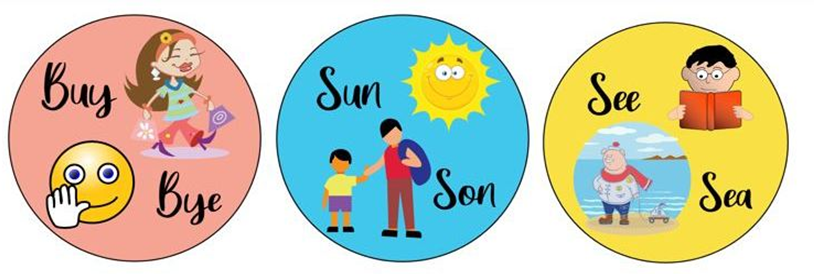
Homophones are words that sound the same when pronounced but have different meanings and often different spellings. The term comes from the Greek words “homo,” meaning “same,” and “phone,” meaning “voice” or “sound.”

Understanding homophones is important for reading and writing fluently because using the wrong homophone can change the meaning of a sentence.

Examples of Homophones:
Bare and Bear:
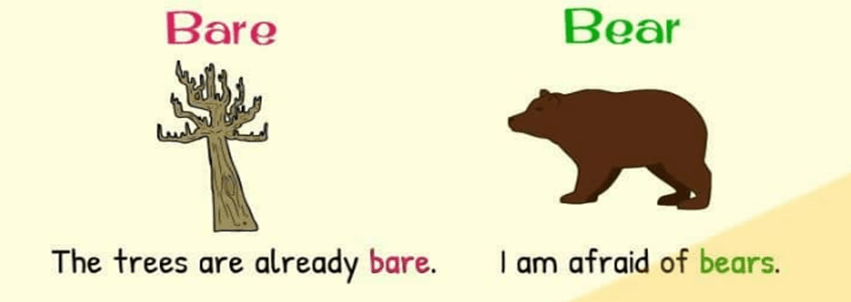
- Bare: Without covering or clothing (e.g., “Her feet were bare.”)
- Bear: A large mammal or to carry (e.g., “I saw a bear in the zoo.” or “He will bear the burden.”)
Flour and Flower:

- Flour: A powder made by grinding grains, used in baking (e.g., “I need flour to bake a cake.”)
- Flower: The blossom of a plant (e.g., “The garden is full of beautiful flowers.”)
Buy and By:

- Buy: To purchase something (e.g., “I will buy some groceries.”)
- By: Preposition indicating proximity or agency (e.g., “The book is by the lamp.” or “This song is by Adele.”)
Write and Right:

- Write: To form letters or words on a surface (e.g., “Please write your name.”)
- Right: Correct or direction opposite of left (e.g., “You got the right answer.” or “Turn right at the corner.”)
Blew and Blue:

- Blew: Past tense of blow (e.g., “The wind blew all night.”)
- Blue: A color (e.g., “The sky is blue today.”)
Importance of Homophones:
- Reading Comprehension:
- Recognizing homophones helps readers understand the correct meaning of words in context, which is crucial for understanding texts accurately.
- Writing Accuracy:
- Using the correct homophone in writing is essential for clear communication. Mistakes can lead to misunderstandings.
- Vocabulary Development:
- Learning homophones expands vocabulary and helps students distinguish between words that sound alike but have different meanings.

Tips for Learning Homophones:
Context Clues:
- Use context to determine which homophone fits best in a sentence. The surrounding words can give hints about the correct meaning.
Practice and Repetition:
- Regular practice with worksheets, reading, and writing exercises helps reinforce the correct usage of homophones.
Visual Aids:
- Use pictures and word cards to associate meanings with the correct spellings of homophones.
Mnemonics:
- Create memory aids or phrases to remember the differences between homophones (e.g., “You put flour in a recipe, and flowers in a vase”).
By understanding and practicing homophones, students improve their language skills and become more proficient readers and writers.
 Read It Yourself Educational Resources
Unlock Your Potential NOW with $530 Off Premium Software Solutions! Don’t Let This Opportunity Slip Away – Upgrade Your Tech Game Today!
https://slickwaves.com
LikeLiked by 1 person
Ever felt the crushing weight of financial stress? I’ve been there, and I know the struggle is real. But there’s hope! Discover life-changing ways to earn money online from the comfort of your home. After years of trial and error, I found the methods that truly work. Let me guide you to financial freedom with passion and proven strategies. Click here to transform your future today https://slickwaves.com/
Thanks and look forward to seeing you inside the community
LikeLiked by 1 person
⚠️ ATTENTION: final hours to take advantage of the $490 discount! https://slickwaves.com/ to start your journey to financial freedom today!
Thanks and look forward to seeing you inside the community
LikeLiked by 1 person