Choose the most suitable response for each question by circling A, B, C, or D.
- Who introduced slavery in the Caribbean?
a. English b. Spanish c. French d. Dutch
2. Why were the Africans brought to work as slaves on the sugar plantations?
a. They were the cheapest to buy b. They were easier to capture
c. Tainos/ Amerindians slavery was abolished in the Caribbean
d. After many Tainos died there was great demand for African slave labour
3. Which historical experience of the Caribbean people would you associate with the harsh treatment of Africans workers on the sugar plantations?
a. Independence b. Slavery c. Colonization d. Emancipation
4. Which of the following was not a reason why the Europeans came to the Caribbean?
a. To import African Slaves b. To find a new route to the east
c. To find Gold d. To control the spice trade
5. Jamaica was colonized in 1655 by the ____________________.
a. French b. Dutch c. English d. Spanish
6. Which pair came to the region voluntarily?
a. Africans and Chinese b. Tainos and Africans
c. East Indians and Chinese d. East Indians only
7. Which of the following task is LEAST LIKELY to be performed by a house slave?
a. Cleaning house b. Baby sitting c. Preparing meals d. Cutting cane
8. Which is not a byproduct of sugar cane?
a. Bagasse b. Molasses c. Rum d. Cotton
9. Which group belongs to the set of low lands?
a. Hills and plateau b. Plain and valley c. Plateau and peak d. Mountain and valley
10. Complete the following analogy. John Crow Mountain is to eastern Jamaica as ___________________ is to western Jamaica:
a. Mocho Mountain b. Santa Cruz Mountain c. Dolphin Head Mountain d. May Day Mountain
11. Which part of Jamaica is most likely to receive relief rainfall?
a. Southern plains b. Eastern mountain regions c. Western hilly areas d. Northern mountains
12. Identify the reason that best supports why mountain temperatures are lower than those on the plains.
a. The air at higher altitude contains more moisture to absorb heat.
b. The air at high altitude contains less moisture to absorb heat.
c. Mountain air is thinner so it is less able to absorb and retain heat.
d. Mountain air is not easily reached by rising heat.
13. How do mountains benefit Jamaica?
i. They are sources of rivers.
ii. They provide large watersheds which improve water catchment.
iii. They are the locations for forests which absorb CO2 from the atmosphere.
a. I and II b. I and III c. I, II and III d. none of the above
14. Which of the following conditions cause mountain crops to thrive?
a. High temperatures and low rainfall b. Low temperature and low rainfall
c. Low temperature and frequent rainfall d. High temperature and frequent rainfall
15. Complete the following analogy. Aconcagua is to South America as __________________ is to Asia:
a. Mt. Blanc b. QMt. Everest C. Visson Massif D. Mt. Mckinley
16. Mountain communities supply resources for all the following except:
a. fishermen. b. carpenters c. charcoal vendors d. petroleum vendors
17. All of the following attract tourists to the mountains, except:
a. beautiful scenery b. indigenous wildlife
c. waterfalls, rapids and river rafting d. excellent transport networks
18. Which of the following is NOT a way of caring for mountain environments?
a. Contour ploughing b. Mulching plants on slopes
c. Collecting rare plants d. Reafforestation
19. Which set has an odd one out?
a. Pacific, Atlantic, Arctic b. Nile, Volga, Murray Darling
c. Asia, Africa, Artic d. Cuba, Puerto Rico, Hispaniola
Use the diagram to answer the questions which follow:
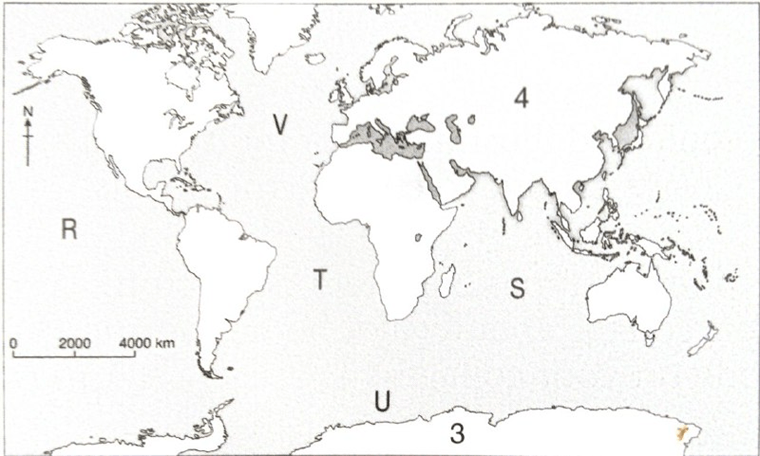
20. Identify the continent at 4:
a. Africa b. North America c. Asia d. Europe
21. Which letter identifies the Atlantic Ocean?
a. T b. U c. V d. S
22. Identify the set which shows continents in ascending order based on size.
a. Europe, Africa, North America, Asia b. Australia, Europe, South America, Africa
c. Asia, Africa, North America, South America d. Antarctica, Asia, Africa, North America
23. All the following – gulf, bay and peninsula – are:
a. inland features b. river features c. coastal features d. landforms
24. All are sources of fresh water except:
a. pond b. lake c. river d. sea
25. Which is not an archipelago?
a. The Bahamas b. Windward Islands c. Lesser Antilles d. Central America
Section B
Complete the table below showing some of the needs of Europeans and Africans on the plantation how they were met.
| Needs | Europeans | Africans |
| Shelter | Great House | |
| Food | Rations provided by the Europeans and ground provision grown themselves | |
| Family Life | Lived with their families in the Great House |
Fill in the blanks with the following terms:
| continent, island, ocean, sea, lake, river, bay, gulf, peninsula, isthmus, archipelago |
My grandpa grew up on a strip of land connected to Jamaica called Titchfield _______________________. He loved to travel from one ______________________ to the next on his boat. On one trip, he started at a _________________in Westmoreland called Orange Bay and headed towards the________________called the Lesser Antilles. This group of islands is surrounded by the Caribbean _____________ and the Atlantic _____________. He occasionally stopped at different countries like St. Kitts and St. Lucia to experience their music, food and culture. He then travelled to Guyana which is on the_________________ of South America. He saw the Demerara_______________in Guyana’s capital and caught fish to cook and eat. Afterwards, he travelled towards Panama_____________which connects North and South America. After almost three months, he finally reached the ____________________ of Mexico where he eventually settled in a town near a ___________________in Mexico. My Grandpa was an adventurous man.
Examine the table below and answer the questions that follow:
| Parishes | Name of mountain/hill | Height |
| St. Andrew | Catherine’s Peak | 1,537 metres |
| Portland/St. Thomas | Blue Mountain | 2,250 metres |
| Portland | John Crow Mountains | 1,140 metres |
| St. Ann | Albion Hill | 839 metres |
| Westmoreland | Amity Mountain | 104 metres |
| Clarendon | Bull Head Mountain | 845 metres |
| Hanover | Dolphin Head Mountain | 544 metres |
| St. Catherine | Juan de Bolas | 833 metres |
a.) If you were asked to use two additional criteria to rank the mountains above what criteria would you use?
b.) Name the highest peak: __________________________________________________________
c.) In which parish can you find the highest mountain? ______________________________________
Study the map below and use it to answer the questions that follow:

a.) What is the height of the land in the areas with the lowest rainfall? _________________________
b.) What conclusion can you draw about the relationship between the height of the land and the amount of rainfall received?
c.) Describe what happens to the temperature when you travel up a mountain.
Section C
Use complete sentences to answer the following questions.
Define the following terms:
- Culture
- National Symbols
- Loyalty
- Celebration
Identify two differences between the way Europeans and Africans met their needs and explain why this difference existed.
What is the symbolism of the Jamaican national flag?
Draw and colour the Jamaican flag correctly.
What is the meaning of each colour that represents the Jamaican flag?
What is the first three lines of the?
- Jamaican National Pledge.
- Jamaican National Anthem.
- What is a globe?
What are lines of latitude and langitude?
What are climatic zones and how many climatic zones are there?
What are the names of the climatic zones of the world?
Using the globe draw and label the three climatic Zones, differentiate each climatic zone with separate colour.
Section D
Write a profile on one of the national heroes below. the profile should include dates for specific milestones in his life, achievements and how he is honoured and remembered in Jamaica today.
- Marcus Garvey,
- Norman Manley
- Alexander Bustamante
Write a reflection on a lesson learnt from the life of the national hero you have chosen.
Please see other End of year exams for June 2023:
Grade 5 – Math End of Year Exam – June 2023
Grade 5 – Science End of Year Exam – June 2023
Grade 5 – Social Studies End of Year Exam – June 2023
 Read It Yourself Educational Resources
4 thoughts on “Grade 6 – Social Studies End of Year Exam – June 2023”