Skimming and scanning are two essential reading techniques used to locate specific information quickly and efficiently in a text.
Here’s a brief overview of each:
Skimming:
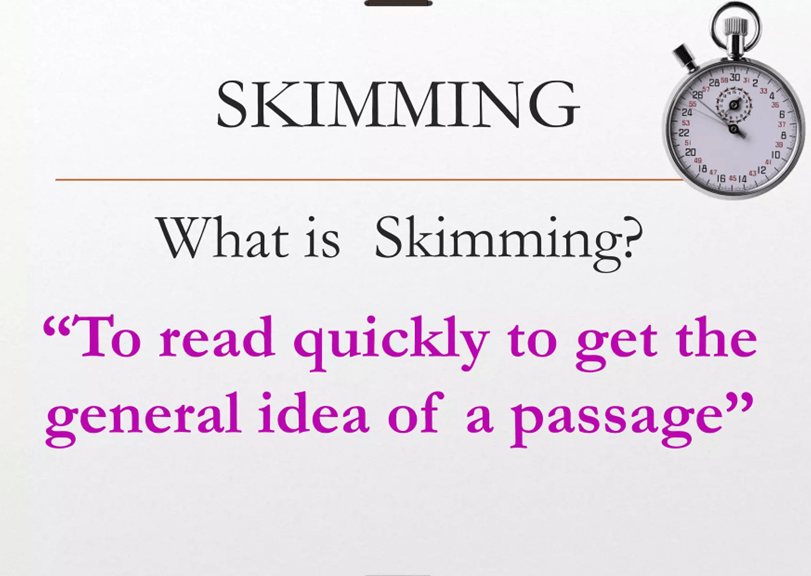
Definition: Skimming involves rapidly reading through a text to get a general overview of its content. The goal is to identify the main ideas, key points, and overall structure of the text without reading every word
Purpose: Skimming is useful when you need to quickly grasp the main ideas of a text, determine its relevance to your needs, or decide whether to read it more thoroughly.
.

Techniques:
During skimming, focus on reading headings, subheadings, topic sentences, and the first and last paragraphs of each section. Pay attention to bolded or italicized text, bullet points, and any visual elements such as charts, graphs, or illustrations. You may also read the introductory and concluding paragraphs of the text to understand its purpose and conclusion.
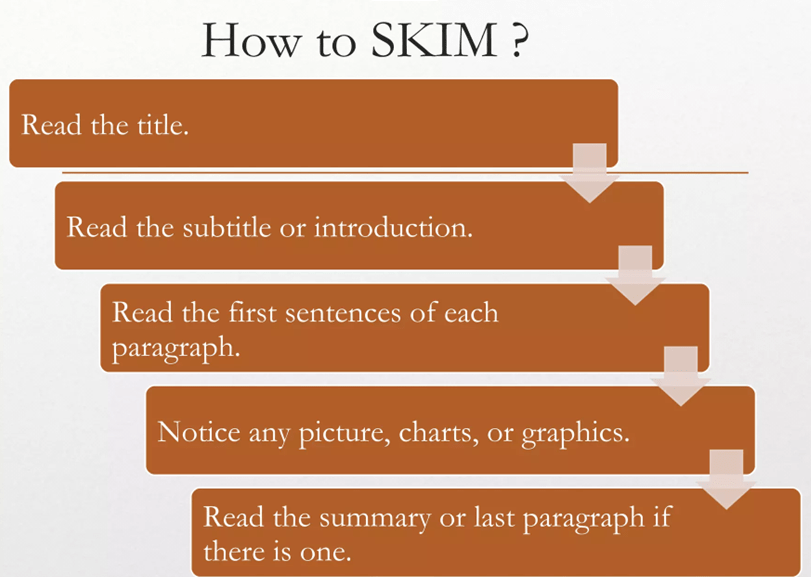
Example: When skimming a newspaper article, you might read the headline, the first paragraph (which often summarizes the main points), and any highlighted or bolded sentences to quickly understand the topic and main ideas.
Scanning:
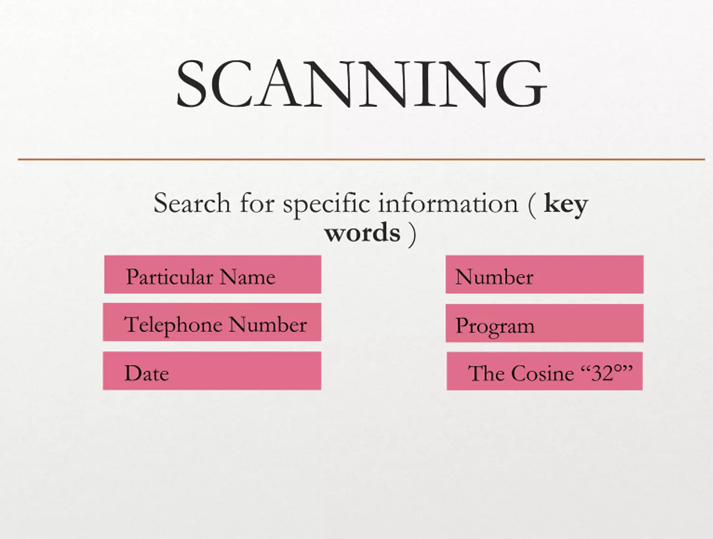
Definition: Scanning involves quickly searching through a text to locate specific information, such as a name, date, statistic, or keyword. The goal is to find the relevant information as efficiently as possible without reading the entire text.
Purpose: Scanning is useful when you need to find specific details or answers to particular questions within a text. It saves time by allowing you to focus on finding the information you need without reading unrelated content.

Techniques: During scanning, use your eyes to quickly move across the text, looking for keywords, numbers, or phrases that match your search criteria. Pay attention to text features such as headings, subheadings, bolded or italicized words, and bullet points, as they can help guide your search. You may also use techniques like using your finger or a pointer to guide your eyes as you scan the text.
Example: When scanning a textbook for information about a specific event in history, you might look for dates, names of people or places, or keywords related to the event, such as “battle,” “leader,” or “outcome.”

Both skimming and scanning are valuable skills that help improve reading efficiency and comprehension. By mastering these techniques, you can quickly find the information you need in a variety of texts, whether for academic, professional, or personal purposes.
 Read It Yourself Educational Resources