


The 3 Reads strategy is a guided learning experience. Students are presented with the problem in stages, and with each read the teacher asks probing questions. Looking at an example is probably the easiest way to understand the protocol, so let’s dive in.



What is the problem or task about?
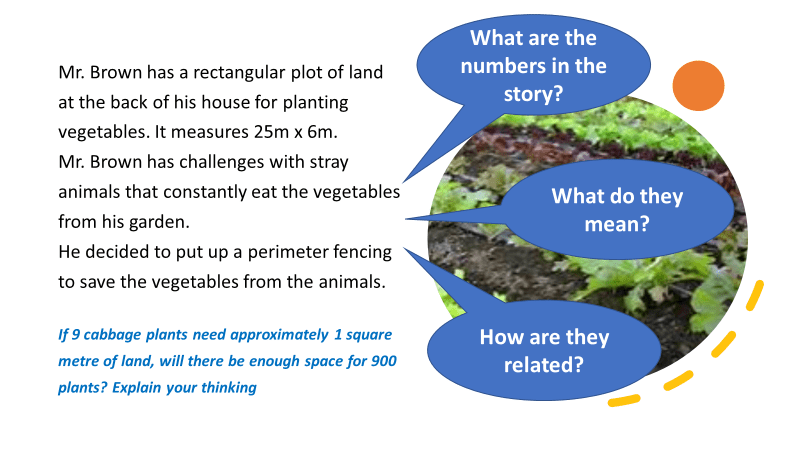
To begin the 3 Reads strategy, the teacher presents the students with a problem, and the class reads the problem together. Probably the easiest way to do this is with a PowerPoint or Google Slides file. Notice that with the first read, there are no numbers and no question. We just want the students to understand what the story is about and make a mental picture. Without numbers, students have to focus on the meaning of the words! After reading the problem together, the teacher asks what the story is about and calls on students for responses. Don’t be surprised if the responses are very general at first (Mr. Brown, animals, etc.). Ask for additional details, if necessary. Ideally, for this problem, you’d like the students to offer the type of garden and vegetables.


What important information are you given?
For the second read, the problem is again presented to the students, but this time it includes the numbers. Read the problem again whole class. The questions you will ask now are all related to the numbers in the story. Our goal is for the students to understand that it’s not just 25m X 6m, it’s length of garden equal 25m and width of garden equal 6m. Students might also offer a relationship —e.g., Mr. Brown’s garden is 25m long and 6m wide.


What question are you answering?
Finally, with the third read, students are asked to generate questions that could be answered using the information in the problem. Even though the problem looks just like it did for the second read, don’t skip the reading part! Some problems won’t lend themselves to very many different questions. I like to use this problem as an example because many different questions can be generated. Why? Because there are different numbers in the problem. Here’s a sampling of questions that could be asked. I’m sure you can think of many others:
- Use a sketch or diagram to represent Mr. Brown’s garden.
- Determine how many metres of fencing will be nedded to fence the vegetable garden.
- If the cost of fencing material is $300.00 per metre, determine the cost of material for the garden.
- If three seedling cost $40.00, what would be the cost of the seedling? How do you know?
That’s the three read strategy in a nutshell! Once a question or questions have been generated, you can have students go on to solve the problem.
After solving each problem, students may explain their by checking their answer. Ask the question: Is your answer reasonable?
See related topics:
Writing and Solving word problems
 Read It Yourself Educational Resources
10 thoughts on “The Three Reads Strategy for Mathematics”